
1.- As Catedrais Beach.

Its original place name, Praia de Augasantas, likely stems from the former presence of a spring of medicinal waters believed by locals to possess miraculous properties.
Today, it is popularly known as Praia de As Catedrais, as its rock formations recall the flying buttresses of magnificent Gothic cathedrals, making this site the Cantabrian mecca of natural Gothic architecture.
Over the centuries, the powerful waters of the Cantabrian Sea carved out what now appears to be a whimsical creation of nature. With their extraordinary shapes, the rock formations at As Catedrais Beach are striking; they resemble a meticulously crafted stage set more than a mere succession of sea caves, passageways, and arches, making it one of the most beautiful beaches in the world.
2.- Torre de los Moreno

It was built between 1915 and 1917 by the brothers Juan and Pedro Moreno y Ulloa, following the designs of the Argentine architect Julián García Núñez.
With its elegant, modern air, the tower—built of concrete, glass, and wrought iron—drew the admiration of locals and visitors alike at the time, thanks to both its sophistication and its innovative design.
The building was unusual, featuring three distinct facades and distinguished by its Modernist elements and an ornamental dome that culminates in a tower.
It has been designated an Asset of Cultural Interest (BIC) since 1997.
3.- Ría de Ribadeo

The Ribadeo Estuary is the town's most distinctive landmark and forms the natural boundary between Asturias and Galicia, which are connected by the Puente de los Santos bridge.
This area of great beauty offers the chance to enjoy immense biodiversity; the mixing of the river's fresh water and the sea's saltwater creates a unique ecosystem that serves as a refuge for a wide variety of species and has been designated a Special Protection Area for Birds (SPA) since 1989.
Furthermore, the estuary is part of the Natura 2000 network. It had previously been designated a Wetland of International Importance under the Ramsar Convention (a transnational agreement to protect waterfowl habitats) and, due to its great biodiversity, was declared a Biosphere Reserve in 2007.
Throughout history, a multitude of fishing and shellfish-harvesting activities have taken place at this location, alongside maritime trade and recreational boating activities.
This long list of activities and possibilities adds even more value to this natural space.
It has a shallow average depth, and at low tide, sandbanks emerge that cause dramatic changes in its appearance, depending on the state of the tides.
4.- Pancha Island

The town's two lighthouses are located on Ribadeo's Isla Pancha. The older one, which has a square footprint, was built in the 19th century.
Inaugurated on December 30, 1859, its mission was to light the entrance to the port of Ribadeo. It consists of a tower set within the center of a square building that helps protect it from storms and heavy seas.
During the final third of the 20th century, a second lighthouse was built on the island—a circular tower with greater range, decorated with black and white stripes.
Currently, the first lighthouse has been converted for tourism, and the Isla Pancha area attracts an increasing number of visitors due to its immense charm and beauty.
5.- O Cargadoiro.
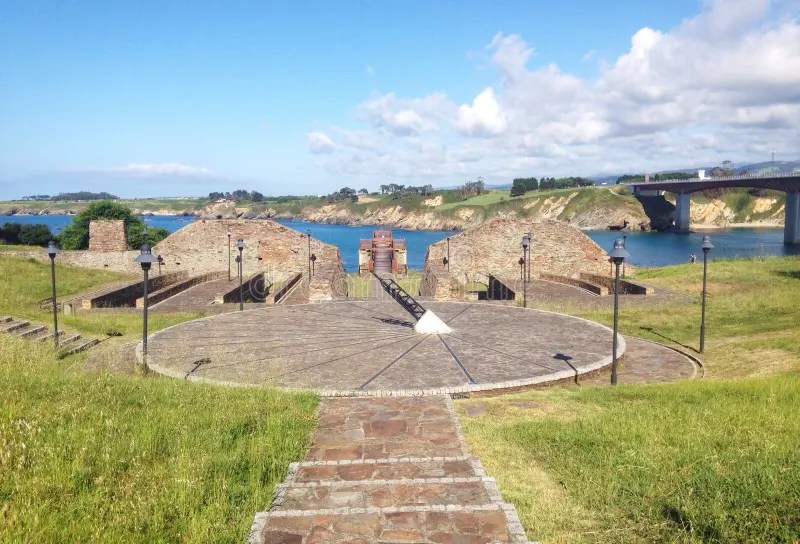
The name derives from the old iron ore loading dock—serving the mines of Villaodriz (A Pontenova)—that existed in the area from the early 20th century until the mid-1960s, when the mines closed.
During that period of intense activity, a crane was used to transfer cargo from trains to the ships waiting below; this facilitated trade with deep-draft vessels by sparing them the need to enter the estuary and rely on the rise and fall of the tides.
The railway line, which spanned a total of 32 kilometers, was closed and the rails were removed in 1966.
The current structure is a reconstruction modeled after the original, consisting of two stone pillars, a metal framework, and a wooden walkway. It is one of the most beautiful spots in the town of Ribadeo, offering views of both the estuary and the neighboring Asturian villages.
6.- Área recreativa y Mirador de Santa Cruz.

The Santa Cruz viewpoint is located about three kilometers from Ribadeo; from there, one can see the central area of the estuary—between the towns of Castropol and Figueras—as well as the river mouth and the entire coastline stretching as far as Tapia de Casariego
Four elements stand out at this site: the Chapel of Santa Cruz, the monument to the Galician bagpiper, and two crosses—one large and made of stone, and another that is smaller and older.
It also features a recreational area with a children's playground, as well as stone tables, benches, and barbecue areas
The Xira de Santa Cruz—a celebration of Galician Bagpipe Day and a very popular, well-attended open-air festival—takes place in this area on the first Sunday of August. The Xira has been designated a Festival of National Tourist Interest.
7.- Cabanela y Puerto de Porcillán.


The town of Ribadeo was founded here, beside the estuary. Originally, it consisted of two separate settlements situated next to a large stretch of sand.
Tradition holds that in the 13th century, Bishop Don Paio lived in the tower located near the A Cabanela auditorium, back when Ribadeo was the seat of the diocese.
Porcillán was always the most important wharf, and pilgrims crossing the estuary by boat would arrive there.
The site of the Cabanela open-air auditorium, located on the seafront promenade, was a beach before the promenade was built.
8.- Capilla de la Trinidad o Atalaya. Ascensor panorámico.

A Atalaia stands on the Porcillán wharf overlooking the Ribadeo Estuary; for centuries, it helped ships align their course and served as a crucial point in the defense of the port and the town.
The chapel—formerly known as the Chapel of the Holy Trinity—is one of the oldest structures in Ribadeo, and its façade preserves a 14th-century doorway featuring Gothic-style ornamentation. Inside, three altarpieces are housed, one of which came from the former collegiate church of Santa María.
The viewpoint is connected to the Porcillán dock by a panoramic elevator, offering beautiful views of the estuary.
9.- Pazo de Ibáñez

This urban *pazo* was built in the late 18th century by Don Antonio Raimundo Ibáñez, an Asturian by birth who made Ribadeo his home.
Ibáñez made a fortune in trade, founded an industrial complex dedicated to smelting and ceramics at Sargadelos, and played an active role in local politics, holding various positions on the town council—on whose staircase a sculpture commemorates him.
10.- Barrio indiano de San Roque

Tradition and innovation are the most fitting words to describe this area of Ribadeo—the quintessential *Indiano* neighborhood.
The tradition represented both by the Jacobean pilgrimage—embodied by the Chapel of the Virgen del Camino—and by the attachment to patron saints venerated in the numerous chapels scattered throughout the municipality, in this instance, the Chapel of San Roque.
Innovation arrived with the first returning emigrants in the 1870s, who built their homes in this area—which, at the time, lay on the outskirts of the town.
Vivid colors, elegant décor, and graceful forms transport us to a new, sophisticated, and cosmopolitan lifestyle. These are spacious homes—featuring large windows and gardens—inspired by the styles that once defined Buenos Aires, Havana, and even Paris.
On both sides of this street, one can see this type of structure, which clearly differs from standard dwellings.
11.- Rinlo

Rinlo is a traditional fishing village situated on a medieval harbor. Along with the one in Ribadeo, it is one of the only two historical ports in the area.
This fishing village, home to one of the oldest fishermen's guilds in Spain, originated at one of the few suitable inlets along this coast: the A Areosa cove.
Rinlo retains its characteristic charm, featuring small seaside cottages arranged along narrow streets to shield them from strong winds, as well as houses with vegetable gardens and *hórreos* (traditional raised granaries)—homes belonging to locals who have traditionally worked both the sea and the land.
The quality of its seafood—the star product of its cuisine—is widely renowned, with the spiny lobster standing out in particular. Facilities for farming them were built as early as the beginning of the 20th century; although they are no longer in use today, they attract numerous visitors.
In addition, the "Festa do Percebe" (Goose Barnacle Festival) takes place every year between July and August, depending on the tides, featuring tastings of this and other seafood, as well as a very lively atmosphere in the town.
12.- Casco histórico de Ribadeo

The streets of Ribadeo's historic center contain a large number of the buildings that led to the area being designated a BIC (Asset of Cultural Interest) in 2004.
This area blends various architectural styles, ranging from the modest homes of artisans and sailors to buildings such as *indiano* mansions, banking houses, and the residences of ship-owning families.
Among the most distinctive buildings are the Old Customs House (18th century), San Damián Castle (18th century), and the Plaza del Campo (also known as Plaza de España)—the town's central hub—surrounded by structures such as the Pazo de Ibáñez, the Torre de los Moreno, the Convent of Santa Clara, and the Church of Santa María del Campo, which traces its origins back to an old 13th-century Franciscan convent.
Ribadeo's historic center is ideal for a day of shopping at the town's various businesses while enjoying its unique streets.
It is also a fantastic option for going out for tapas and enjoying the gastronomy of Ribadeo.
13.- El Fuerte de San Damián

It is situated at the mouth of the estuary and is the finest example of military architecture in Ribadeo.
The fort was built in 1624 by the Marquis of Cerralbo at a strategic, hard-to-reach location. Its mission was to protect the entrance to the estuary against potential attacks from the sea, for which purpose it was equipped with artillery. Previously, a tower known as Torre Nova had stood on the site.
It was destroyed by the British in 1719, rebuilt, and reduced to ruins once again following an explosion in 1809 during the War of Independence.
It subsequently came under the ownership of the City Council, which carried out its restoration. The fort is situated in a location offering spectacular views of Ribadeo and its estuary.
14.- Convento de Santa Clara

It was originally a beguinage founded in the 11th century that was transformed into a convent in 1366.
It survived a devastating fire in the 16th century, and in the second half of that century, a chapel dedicated to Saint Peter was founded.
In 1809, the structure was severely damaged and also lost a significant portion of its archive when it was occupied by Napoleon's troops during the Peninsular War.
Between 1810 and 1812, the building served as a military hospital and subsequently as a shelter for sick transients.
Currently, the convent consists of a rectangular building that houses the church—preserved with its original structure—and an interesting collection of religious images, some of which date back to the medieval period.
15.- Plaza de España

It currently serves as the center of the town, even though it was once a peripheral area, given its location just outside one of the medieval city gates.
Surrounding it stand historic buildings such as the Neoclassical Ibáñez Palace (currently the seat of the City Council), the Torre de los Moreno, the old Customs House, and the Tourist Office.
16.- Iglesia Parroquial de Santa María do Campo

It was formerly a Franciscan convent—founded by Saint Francis of Assisi himself during his pilgrimage to Santiago—until 1835, when it became the Parish Church of Santa María del Campo.
Over time, it underwent various renovations and currently combines artistic elements from different eras: Baroque and Neoclassical statuary, as well as 20th-century architectural features.
17.- Casa Patín

It is the oldest civic building in Ribadeo. Of medieval origin, it still retains the façade from that period, although it was renovated in the 20th century and the original *patín*—the external staircase that gave the house its name—was removed.
The house belonged to the Méndez Gavia lineage—a local family that amassed wealth through the timber trade for shipbuilding during the 18th century. It later passed into the hands of the Pardo Montenegro family.
Next to it stands the Municipal Library, which formerly housed the School of Nautical Studies and Commerce, established in 1856.
18.- Aduana Vieja

The coat of arms adorning the façade indicates that this monumental building was constructed in 1726, originally serving as a stately residence belonging to Carlos Acevedo Pardo.
The establishment of a customs post in Ribadeo is closely linked to the town's commercial development—a factor that enabled the port to handle domestic traffic and, by the 19th century, international trade as well.
This large house once stood by the sea. It is now a hotel.
19.- Cine Teatro

It opened in 1800, becoming one of the driving forces behind cultural life in Ribadeo.
It is built on the site of an old canvas factory constructed by order of Charles III in 1774.
The current facilities date back to 1936, when the building underwent a major renovation to become a movie theater.
20.- Puente de los Santos

It was built in 1987 to serve as a link between Galicia and Asturias. Its construction brought about a genuine transformation and a boost to the area's economic, commercial, and tourism activity.
In 2008, it was expanded to include four lanes and two sidewalks, thereby accommodating the A-8 Cantabrian Motorway and turning Ribadeo into a transit point for anyone traveling between the two regions.
It owes its name to its proximity to two chapels—San Miguel and San Román—located at either end of the bridge, on the Galician and Asturian sides, respectively.